
The Age of the Councils
From Constantine to Chalcedon: how the church argued out who Christ is, which books to read, and what grace means, in the Greek East and the Latin West.
The church around AD 400
Cities of the Roman Empire around AD 400, among them Nicaea and Constantinople, where councils met. No borders are drawn.
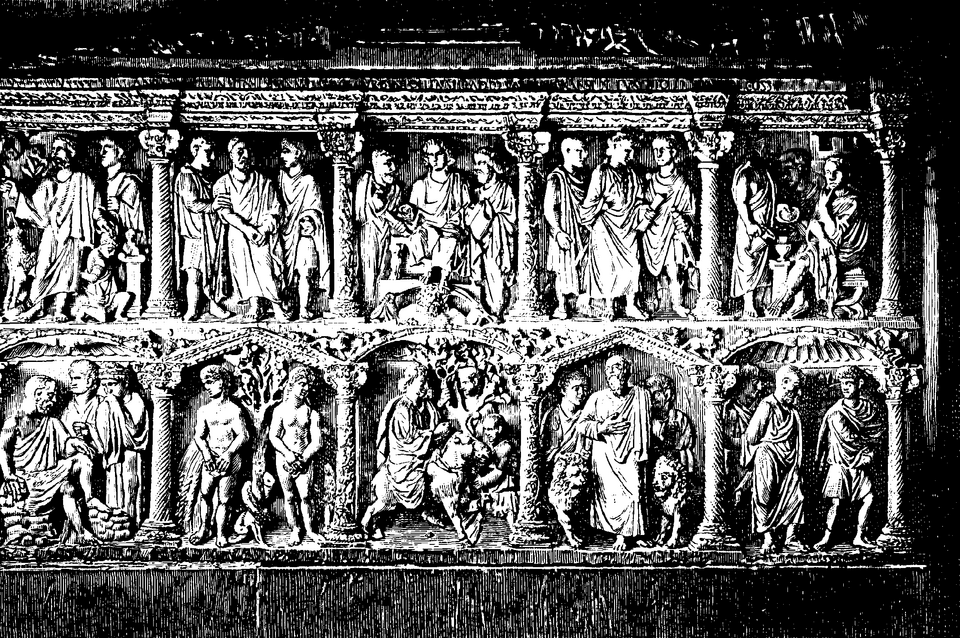
Images from the period
Overview
The previous era ended with toleration. This one starts there. In AD 313 the emperors Constantine and Licinius agreed that Christians could worship freely, and by 325 the bishops were meeting at Nicaea at the emperor’s invitation (Eusebius, Life of Constantine 3.6). The questions the church argued over from then on were no longer how to survive but how to speak: who Christ is, which books to read in church, and what grace means.
The page is arranged by East and West, because the Greek-speaking and Latin-speaking halves of the empire argued about different things in different languages. In the East the main questions were about the Son and the Spirit and, later, about the person of Christ. In the West the main figures, Ambrose, Jerome and Augustine, wrote about church and state, Scripture, sin and grace.
This East and West is a matter of language and region. It is not the later split between the Roman Catholic and Orthodox churches. The splits that began in this era are different: Henry Chadwick describes how the Church of the East did not accept the council at Ephesus, and how the churches now called Oriental Orthodox did not accept Chalcedon.
When were the sources written?
| Writing | Usual date | Notes |
|---|---|---|
| Athanasius, Festal Letter 39 | AD 367 | The date is in the letter’s own heading |
| Socrates, Church History | After AD 439 | Its history ends in 439, the translator says |
| Augustine, Confessions | c. AD 397 | The editor’s date |
| Augustine, City of God | AD 413 to 426 | The editor’s date |
| Leo, Letter 28 (the Tome) | 13 June 449 | The date at the end of the letter |
| Jerome, Preface to the Gospels | AD 383 | In its heading |
Key beliefs and debates
What did the council at Nicaea decide?
It issued a creed that says the Son is begotten, not made, and of one substance with the Father, and it condemns those who say there was a time when he was not (The Seven Ecumenical Councils, the Nicene Creed). A letter in the emperor’s name to those who were absent urges them to keep Easter on one day. The councils collection does not contain a list of Bible books from Nicaea; on this page the lists come from Athanasius in 367 and from the African church, below.
Which books are in the Bible?
Lists differed. Athanasius’s list for the New Testament matches the one most Christians use today: four Gospels, Acts, seven catholic letters, fourteen letters of Paul including Hebrews, and Revelation. He says other books, including the Shepherd and the Teaching of the Apostles, are not in the canon but may be read to new believers. The African canon’s list also has the same New Testament books, but its Old Testament includes Tobit, Judith, the Maccabees and Ezra, and it says nothing but canonical Scripture is to be read in church. Churches still differ on the Old Testament books to this day. How the lists came about is debated; Harry Gamble’s The New Testament Canon describes the different views.
Who was Arius, and what did he teach?
On this page the Arian side is known only through the people who opposed it. The Nicene creed’s condemnations, such as there was a time when he was not, show what the council took Arius’s position to be. Henry Chadwick discusses how far the opponents’ reports can be trusted, and Rowan Williams’s Arius (Further reading) is a full study.
One person in two natures
The council at Chalcedon says that the one Lord Jesus Christ is perfect in godhead and perfect in manhood, consubstantial with the Father and with us, and must be confessed in two natures, unconfusedly, immutably, indivisibly, inseparably. Leo’s Tome, read at the council, says each form does what is proper to it with the co-operation of the other. Henry Chadwick describes how the definition was rejected by some churches, the ones now called Oriental Orthodox.
Grace and free will
Augustine’s prayer, give what you command and command what you will, came to stand for his side in the dispute with Pelagius. The editor of his anti-Pelagian writings says Pelagius held that people could do whatever God commanded, and was provoked when the prayer was repeated in his presence. Augustine says it appears in his Confessions, written before the dispute, and he argued that even the beginning of faith is God’s gift (On the Predestination of the Saints 3). Christian traditions still differ on how to read the question.
Did Constantine make the empire Christian?
The agreement of AD 313 gave Christians freedom, along with everyone else. The sources on this page show emperors calling councils, writing to bishops and, in Julian’s case, turning back to the old religion; none of them is a law making Christianity the religion of the empire, so this page does not make that claim.
Worship and community life
Monks and the desert
Athanasius’s Life says Antony was moved by hearing the Gospel passage in which Jesus tells a rich man to sell what he has and give to the poor. Augustine says the story was in his mind when he heard the voice in the garden. The Life shows a new kind of Christian life, lived apart in the desert.
Bishops and emperors
Ambrose’s letter to Theodosius shows a bishop telling an emperor that he dared not offer the sacrifice in his presence until he repented (Letter 51.13). The editors of Ambrose say the emperor did penance and was readmitted to communion.
What was read in church
The African canon says that besides the canonical Scriptures nothing is to be read in church under the name of divine Scripture, and gives the list. The notes add that the earlier version at Hippo also allowed the accounts of the martyrs to be read on their anniversaries. Athanasius allows some books to be read to new believers that are not in the canon. The two together show that reading in church and the canon were not yet the same thing everywhere.
Glossary
| Term | Meaning on this page |
|---|---|
| Apocrypha | Books outside the lists some churches accept as Scripture, such as Tobit and Judith in Athanasius’s and the African lists |
| Canon | The list of books accepted as Scripture |
| Consubstantial | Of one substance. The word used at Nicaea and Chalcedon |
| Council | A meeting of bishops to settle a question |
| Creed | A short statement of belief, such as the Nicene Creed |
| Donatists | North African Christians who would not accept bishops they thought had given up Scripture in persecution |
| Festal letter | A letter a bishop of Alexandria sent out each year announcing the date of Easter |
| Monk | One who leaves ordinary life to live apart in prayer |
| Nature | In the Chalcedon definition, the divine or the human side of Christ |
| Pelagianism | The view, as Augustine describes it, that people can do all that God commands |
| Tome | Leo’s letter to Flavian, bishop of Constantinople |
Further reading
Modern scholarship is cited here, not copied. Titles and years were checked against the Open Library catalogue in November 2026.
- Henry Chadwick, The Early Church (Pelican History of the Church; Penguin, 1993 printing of the revised edition). The general framework, again.
- Harry Y. Gamble, The New Testament Canon: Its Making and Meaning (1985). How the lists of books came together.
- Rowan Williams, Arius: Heresy and Tradition (1987). What Arius taught and how we know.
- Peter Brown, Augustine of Hippo (1967). A biography.
- J. N. D. Kelly, Early Christian Doctrines (1958). How the creeds and Chalcedon developed.
- Timothy D. Barnes, Constantine and Eusebius (1981). Constantine’s Christianity.
Key events
West: The Donatist dispute begins in North Africa
The translator of our Eusebius says the schism began when Caecilian was chosen bishop of Carthage in 311: his opponents said the bishop who ordained him had handed over the Scriptures in the persecution, and they chose a rival bishop. The Donatists appealed to Constantine, a synod at Rome decided against them in October 313, a council at Arles did the same the next year, and the emperor confirmed it at Milan in 316. Decades later Augustine, as the editor of his anti-Donatist works summarizes him, answered that the church is a net holding good and bad together until the end, and set the Donatists' violent wing, the Circumcellions, over against the Catholic side. The same editor notes that both parties claimed to be the true Catholic church.
East: The council at Nicaea
The council's creed says the Son is begotten, not made, of one substance with the Father, and condemns anyone who says there was a time when the Son was not, or that he was made from nothing, or is of a different substance, or is a creature. Our collection of the councils calls it the faith of the 318 fathers. Eusebius, who was there, says more than two hundred and fifty bishops came; the editor notes that other ancient writers give 270, 300 or 318. A letter in the emperor's name to churches not at the council urges them all to keep Easter on one day.
East: Athanasius and the struggle over Nicaea
Athanasius was bishop of Alexandria from 328 until his death in 373, and his writings defend both himself and the council. The editor of his works counts five exiles, which he dates 335 to 337, 337 to 346, 356 to 362, and two more between 362 and 366.
East: Antony and the monks of the desert
Athanasius's Life says Antony was moved by the story of the rich man, gave away his land, and went to live apart, and that he was nearly a hundred and five when he died. The editor gives Jerome's date for his death, AD 356. Augustine says hearing of Antony's conversion helped bring about his own.
East: Julian tries to restore the old religion and is killed in Persia
Socrates says Julian, proclaimed emperor at Constantinople in December 361, opened the pagan temples, offered sacrifice and recalled the bishops his predecessor had exiled. He invaded the territory of the Persians, laid siege to Ctesiphon, and refused the Persian king's offers of peace; the translator dates this to AD 363. The story that Julian died crying out to the Galilean is told by Theodoret, and Socrates does not report it.
East: Athanasius lists the books of the Bible
In his Festal Letter for 367 Athanasius says there are twenty-two books in the Old Testament and lists the books of the New Testament: the four Gospels, Acts, seven letters called catholic, fourteen letters of Paul (counting Hebrews), and Revelation. He says no one is to add to them or take from them. He adds that some other books, among them the Wisdom of Solomon, Sirach, Esther, Judith, Tobit, the Teaching of the Apostles and the Shepherd, are not in the canon but are appointed to be read to those new to the faith.
East: The council at Constantinople
The council is remembered for the creed of the 150 fathers, which confesses the Holy Ghost as the Lord and Giver of Life, who proceeds from the Father and with the Father and the Son is worshipped and glorified. Its text survives in the acts of the council at Chalcedon, where it was read out. The editor notes that Tillemont and Hefele thought the council adopted a creed already in use rather than writing a new one.
West: Ambrose writes to Theodosius after Thessalonica
The editors say that after a mob at Thessalonica killed officers of the garrison, the emperor's orders led to the deaths of over seven thousand people. Ambrose, bishop of Milan, wrote to him: I dare not offer the sacrifice if you intend to be present. He urged repentance, and the editors say the emperor did penance and was readmitted to communion.
West: Jerome and the Latin Bible
At Rome, between 382 and 385, Jerome revised the Latin New Testament at the request of Damasus, bishop of Rome. His preface to the Gospels, addressed to Damasus in 383, begins: You urge me to revise the old Latin version. At Bethlehem he translated the Old Testament from the Hebrew, beginning in 391 and finishing in 404, the editors say.
West: African churches list the books of the Bible
A canon in the code of the African church says that nothing besides the canonical Scriptures is to be read in church as divine Scripture. Its list of the New Testament is the four Gospels, Acts, fourteen letters of Paul, two of Peter, three of John, one of James, one of Jude, and Revelation. Its Old Testament includes Tobit, Judith, Esther, Ezra and the Maccabees. The covering note asks that the list be sent to Boniface, bishop of Rome. The notes say the canon repeats canon 36 of the council at Hippo in 393, and the editor dates the council at Carthage that adopted the African code to 419.
West: Augustine writes his Confessions
Augustine describes hearing a child's voice chant take up and read, taking up the letters of Paul, and reading the first passage he saw, which was Romans 13:13 to 14. Just before, he says he had thought of Antony, who had heard the Gospel read as though it were addressed to him.
West: Alaric sacks Rome, and Augustine writes the City of God
The City of God opens by saying that even those who are now enemies of the name of Christ were spared by the barbarians out of respect for Christ and found safety in the churches of the apostles and the shrines of the martyrs. The editor says Augustine refers to the sack of Rome by the Goths under Alaric in 410, that Alaric was a Christian of the Arian kind, and that he spared the Catholic Christians. The editor also says Augustine worked on the book from 413 to 426.
West: Pelagius and Augustine on grace
Augustine says that his prayer give what you command and command what you will, written in the Confessions, was repeated to Pelagius in Rome, who objected to it. The editor of his anti-Pelagian works says Pelagius believed people could do all that God commanded, that the controversy broke out after Pelagius and his follower Coelestius reached Africa in 411, and that the African bishops, meeting at Carthage in 418, kept their sentence against Pelagius and Coelestius in force. Augustine argued that even the beginning of faith is God's gift.
East: The council at Ephesus and Nestorius
Celestine of Rome had already approved Cyril's doctrine and given Nestorius ten days to reject his refusal to call the Virgin Mary Mother of God. At Ephesus the council's decree says Nestorius did not answer its summons, that it examined his teaching, and that, compelled by the canons and by Celestine's letter, it excluded him from the episcopal dignity and all priestly communion. Henry Chadwick describes how churches east of the empire, now called the Church of the East, did not accept the council.
East and West: Leo's Tome and the council at Chalcedon
Leo of Rome's Tome says that in Christ one who is true God is also true man, and that each form does what is proper to it. It was read at the council, which received it in its definition. The definition says that the one Lord Jesus Christ is perfect in godhead and perfect in manhood, consubstantial with the Father and with us, to be confessed in two natures, unconfusedly, immutably, indivisibly, inseparably. Henry Chadwick describes how some churches, now called the Oriental Orthodox, refused the definition.
Key people
Constantine
The emperor of the Milan agreement of AD 313 (see the previous era). A letter in his name to churches not at Nicaea, preserved in the collection of the councils, urges all churches to keep Easter on one day and says Christ left only one festal day of redemption. Eusebius says Constantine called the council at Nicaea by letter and helped the bishops travel there. How sincerely and in what way he was a Christian is debated; Henry Chadwick discusses the question.
Athanasius
Bishop from 328 until his death on 2 May 373, according to the editor of his works, and sent into exile five times between 335 and 366. His writings include a defense of his own conduct and his thirty-ninth Festal Letter for the year 367, which lists the books of the Old and New Testaments. He is also the author of the Life of Antony.
Antony
Athanasius says Antony, a young man from a Christian family in Egypt, went into church some months after his parents died, heard the Gospel passage in which Jesus tells a rich man to sell what he has and give to the poor, and went out and gave his land to the villagers. At his death, the Life says, he was nearly a hundred and five years old. Augustine later says that hearing this story helped bring about his own conversion.
Julian
Socrates says Julian was a Christian at the beginning and served as a reader in the church at Nicomedia, but as emperor opened the pagan temples and offered sacrifice. He led the army into Persia and died there in AD 363. Theodoret relates that the dying emperor threw his blood into the air and cried, Thou hast won, O Galilean; Socrates does not tell this story.
Ambrose
After the massacre at Thessalonica he wrote to the emperor Theodosius: I dare not offer the sacrifice if you intend to be present. He called on him to repent. The editors say the emperor did penance and was readmitted to communion.
Augustine
In his Confessions he tells how, in a garden, he heard a child's voice say take up and read, opened the letters of Paul, and read Romans 13:13 to 14. After the sack of Rome he wrote the City of God, answering those who blamed Christians for the disaster. Against the Donatists he argued that the church is a net holding both good and bad until the end; against Pelagius he defended his prayer give what you command and command what you will.
Pelagius
According to the editors of Augustine's anti-Pelagian writings, Pelagius held that people can do all that God commands, and could not bear to hear Augustine's prayer give what you command repeated in his presence. Augustine himself says he said this in the Confessions before the Pelagian dispute arose.
Cyril of Alexandria
Opponent of Nestorius. According to the historical introduction in the councils collection, Celestine, bishop of Rome, approved Cyril's letters and doctrine, rejected Nestorius's refusal to call the Virgin Mary Mother of God, and decreed that he would lose his office and communion unless he rejected this innovation within ten days. The council at Chalcedon later received Cyril's letters to Nestorius.
Leo of Rome
His letter 28 to Flavian, called the Tome and dated 13 June 449, argues that in Christ one who is true God is also true man, and that each form does what is proper to it with the co-operation of the other. It was read at the council at Chalcedon, where the bishops cried out that Peter has spoken thus through Leo.
Sources for this era
- Letter of the Emperor, creeds, Chalcedon, Ephesus and the African code, The Seven Ecumenical Councils, Nicene and Post-Nicene Fathers, second series, volume 14 (CCEL)
- Festal Letter 39; Life of Antony, Athanasius, Nicene and Post-Nicene Fathers, second series, volume 4 (CCEL)
- Church History, Socrates, Nicene and Post-Nicene Fathers, second series, volume 2 (CCEL)
- Letter 51, Ambrose, Nicene and Post-Nicene Fathers, second series, volume 10 (CCEL)
- Church History, Theodoret, Nicene and Post-Nicene Fathers, second series, volume 3 (CCEL)
- Preface to the Four Gospels, Jerome, Nicene and Post-Nicene Fathers, second series, volume 6 (CCEL)
- Church History; Life of Constantine, Eusebius, Nicene and Post-Nicene Fathers, second series, volume 1 (CCEL)
- Letter 28 (the Tome), Leo the Great, Nicene and Post-Nicene Fathers, second series, volume 12 (CCEL)
- Confessions; City of God; writings against the Donatists; anti-Pelagian writings, Augustine, Nicene and Post-Nicene Fathers, first series, volumes 1, 2, 4 and 5 (CCEL)
- Modern studies of the period, Henry Chadwick; Harry Y. Gamble; Rowan Williams; Peter Brown; J. N. D. Kelly; Timothy D. Barnes