
After the Apostles
From the generation after the apostles to Constantine: bishops and martyrs, the first outside views of Christians, arguments over Scripture, and the shift from persecution to toleration.
Cities named in the sources for this era
Cities named in the writings of AD 100 to 313 that this page uses, from Antioch in the east to Carthage in the west. Lyons and Vienne in Gaul, where Irenaeus was bishop, lie off the western edge of this map.
Images from the period
Overview
This era begins where the Apostolic Age ends. The apostles are gone, and the churches are left with their letters, with memories of the apostles, and with leaders called bishops, elders and deacons. It ends with the first Christian emperor. Between those two points lie about two hundred years in which Christianity grew from a small and mostly unnoticed movement into one that Roman emperors tried to destroy and then decided to tolerate.
The evidence is much richer than for the first century, and the story is much less tidy. Writers now argue with each other, with outsiders, and with Christians they regard as dangerous. Most of what we know of the groups they attacked, such as Marcion, the Montanists and the Gnostic teachers, comes from those who attacked them. Dates are often uncertain, and the timeline below says so wherever they are.
The page is built in two parts. The first runs to about AD 200, a period of letters, first outside views, and arguments over what counts as Scripture. The second runs from AD 200 to 313, a period of larger and better-organized churches, empire-wide persecutions, and finally toleration.
When were the sources written?
The dates below are the ones usually given. Most are debated, and several depend on how an old tradition is read. The “Notes” column says what the source is for.
AD 100 to 200
| Writing | Usual date | Notes |
|---|---|---|
| 2 Peter | c. AD 100 to 150 | Often thought to be the latest book of the New Testament |
| Letters of Ignatius | Under Trajan, by tradition | Seven letters, written on the way to Rome. Eusebius’s Chronicle gives AD 107; some put them later |
| Pliny to Trajan, Letters 10.96 and 10.97 | c. AD 112 | Not a Christian source, which is its value |
| Polycarp, To the Philippians | Perhaps mid-second century | The translator says the date cannot be settled |
| Didache, Barnabas, Shepherd of Hermas | c. AD 100 to 150 | Dates debated; the Muratorian fragment places Hermas in Rome under Pius |
| Justin, First Apology | c. AD 150 | Addressed to the emperor Antoninus Pius |
| Martyrdom of Polycarp | Mid-second century | Some argue parts were added later |
| Irenaeus, Against Heresies | c. AD 175 to 189 | While Eleutherus was bishop of Rome |
| Muratorian fragment | Late second century, or the fourth | Debated; see the timeline |
AD 200 to 313
| Writing | Usual date | Notes |
|---|---|---|
| Tertullian, Apology | c. AD 198 to 204 | |
| Passion of Perpetua and Felicitas | c. AD 202 | Includes writing attributed to Perpetua |
| Origen, Against Celsus | Mid-third century | A reply to an earlier book by Celsus |
| Cyprian, On the Unity of the Church, letters | AD 250 to 258 | |
| Lactantius, On the Deaths of the Persecutors | Soon after AD 313 | Written when, it says, all the persecutors were destroyed. Jerome says Lactantius later taught Constantine’s son Crispus |
| Eusebius, Church History | Early fourth century | Our main collection of earlier tradition |
Key beliefs and debates
What did “catholic” mean?
The word comes from Greek and means “universal”. Ignatius uses it in his letter to Smyrna to say that wherever Jesus Christ is, there is the catholic church (Ignatius, Smyrnaeans 8). He is not naming a denomination. He is making an argument about unity: the church is whole wherever the bishop, the elders and the deacons are together. The Muratorian fragment speaks of books that cannot be received into the Catholic Church. When a modern reader sees the word in this period, “universal” is the safe meaning.
Bishops and unity
The first century used several titles for leaders, and scholars debate when a single bishop came to head each church; Henry Chadwick’s The Early Church discusses the question. Ignatius insists on it more strongly than anyone before him: follow the bishop as Jesus Christ follows the Father, he tells the Smyrnaeans, and let nothing be done without the bishop (Smyrnaeans 8). Irenaeus builds his argument against Marcion and the Gnostic teachers on the churches the apostles founded and the bishops who followed them (Against Heresies 3.3). Cyprian, a century later, goes furthest: one who does not have the church for his mother cannot have God for his father (On the Unity of the Church 6). Scholars disagree about how general the single bishop was before Ignatius, and how far his own churches matched what he asks for.
How did the New Testament take shape?
The Apostolic Age ended with a collection of writings in circulation but no agreed list. By the end of this era there is something close to one. The path was not straight, and historians differ on how important any single step was.
Marcion made a short list of his own: an edited Luke and edited letters of Paul, with the prophets and the law set aside (Irenaeus, Against Heresies 1.27.2). Irenaeus answers by defending four Gospels, which he says cannot be more or fewer, and he gives a reason from the four zones of the world and the four winds (Against Heresies 3.11.8). The Muratorian fragment, which may be from the late second century or, as some argue, the fourth, names Luke as the third Gospel and John as the fourth, lists Acts, thirteen letters of Paul and the Apocalypse, and says the Shepherd of Hermas should be read but not placed among the prophets or the apostles. 2 Peter itself, which may be one of the latest writings, speaks of Paul’s letters alongside “the other Scriptures” (2 Peter 3:15 to 16). In the early fourth century Eusebius still counts 2 Peter among the disputed books (Church History 3.25).
Harry Gamble, in The New Testament Canon, describes a gradual process in which churches settled on the books they already used in worship, with outside pressure from Marcion and others sharpening the question. How much weight to give Marcion is debated, and Gamble discusses the different views. See Further reading.
Gnostic teachers
Irenaeus’s Against Heresies is our main source on Valentinus and others whom he calls heretics, and his aim is to refute them. For a long time historians had little else. That changed with the find of a collection of writings in Coptic at Nag Hammadi in Egypt in 1945, published in English as The Nag Hammadi Library in English in 1977. Henry Chadwick’s The Early Church describes the find and how it changed the study of these teachers. Historians differ on how fairly Irenaeus described his opponents and on whether “Gnosticism” is a useful single label.
Montanism
Montanus began to prophesy in Mysia, on the border of Phrygia, and his followers were attacked by writers who called their prophecy false prophecy. The critic quoted by Eusebius writes that he hesitated to refute them for fear of seeming to add to the Gospel of the New Testament, and that the movement “separated” them from the church (Eusebius, Church History 5.16). We know the movement through its opponents. The editor of the Passion of Perpetua says some have thought the martyrs and the writer were Montanists, and Jerome says Tertullian went over to Montanus’s teaching, so the question reaches into the sources we have.
Why was Easter disputed?
The churches of Asia kept the passover on the fourteenth day of the Jewish month, whatever day of the week it fell, while most others kept it on a Sunday (Eusebius, Church History 5.23). The two sides each claimed apostolic tradition. Polycarp visited Rome in the time of Anicetus, and though they disagreed on the question they kept the peace (Church History 5.24). Victor, a generation later, tried to excommunicate all of Asia and was rebuked by other bishops, including Irenaeus. It shows both how strong the pull to uniformity was and how many churches would resist a bishop of Rome.
What did outsiders think?
Pliny’s letter is the earliest official Roman view that survives. He does not call Christians criminals for any particular act. He asks whether the name itself is punishable, and calls their worship a “contagious superstition” (Letters 10.96). Trajan tells him not to hunt Christians out and not to accept anonymous accusations. Celsus mocks Christians as people who work in wool and leather and speak to children in private houses (Origen, Against Celsus 3.55), and he accuses them of meeting in secret against the law (1.1). Robert Wilken’s The Christians as the Romans Saw Them gathers the views of Pliny, Celsus and other pagan writers, and argues that educated Romans took Christianity seriously enough to attack it. See Further reading.
How much were Christians persecuted?
Tradition counts ten persecutions, from Nero to Diocletian. Augustine reports this list as the opinion of “some”, names the emperors, and says he does not think the number was foretold by the ten plagues of Egypt (City of God 18.52). Henry Chadwick and many other modern historians think that before Decius persecution was local and occasional: Pliny shows an official working out what to do case by case, and the Lyons letter concerns one province. The translator of our edition of Eusebius warns that the Lyons persecution should not be called wholesale. Decius in AD 250, Valerian in AD 257 to 258 and Diocletian from AD 303 are different: Eusebius, Cyprian and Lactantius describe measures aimed at bishops, clergy and church property in many places.
Candida Moss argues in The Myth of Persecution that later Christians overstated how often and how widely Christians were killed. Others reply that the sources for Decius, Valerian and Diocletian are strong, as the passages above from Eusebius, Cyprian and Lactantius show. The disagreement is partly about numbers, which no source gives, and partly about how to read martyr stories. See Further reading.
The Edict of Milan
The agreement of AD 313 is the best-known date of the period, and it is often misdescribed. The text we have is an edict that Lactantius says Licinius had published at Nicomedia, addressed to a provincial governor, in which Constantine and Licinius say they had met at Milan and agreed on religious freedom for Christians and everyone else (Lactantius 48). The main toleration decree is two years earlier, Galerius’s edict of AD 311 (Lactantius 34, 35). Both texts grant freedom of worship; neither makes Christianity the religion of the empire.
Worship and community life
We know more about worship now than in the first century, mostly from one source, Justin’s description for the emperor, written to show outsiders that Christians had nothing to hide.
Baptism
Justin says those who are persuaded and promise to live by what Christians teach are taught to pray and fast for forgiveness, and are then brought to water and washed in the name of God the Father, of Jesus Christ, and of the Holy Spirit (First Apology 61). He adds that the baptized are brought to the brethren to pray together (First Apology 65). The Didache, from an earlier time, prefers baptism in running water and allows water to be poured three times on the head if there is not enough water to baptize in (Didache 7).
Sunday
On the day called Sunday, Justin says, everyone in town or country gathers in one place. The memoirs of the apostles or the writings of the prophets are read as long as time allows. The president speaks to urge them to imitate these good things; everyone stands to pray; bread, wine and water are brought; the president prays and gives thanks as well as he can; the people say Amen; and each receives a share, and a portion is sent by the deacons to those who are absent (First Apology 67). The well-off give what they choose, and the collection, kept by the president, helps orphans, widows, the sick, prisoners and strangers.
The Lord’s Supper
Justin explains that they do not take the bread and wine as ordinary food and drink. He compares it to the incarnation: as Jesus was made flesh, so the food blessed by prayer is the flesh and blood of that Jesus (First Apology 66). He says the apostles in their memoirs, which are called Gospels, handed down what Jesus enjoined. Christians continue to read these differently, and this page does not take a side.
Where did Christians meet?
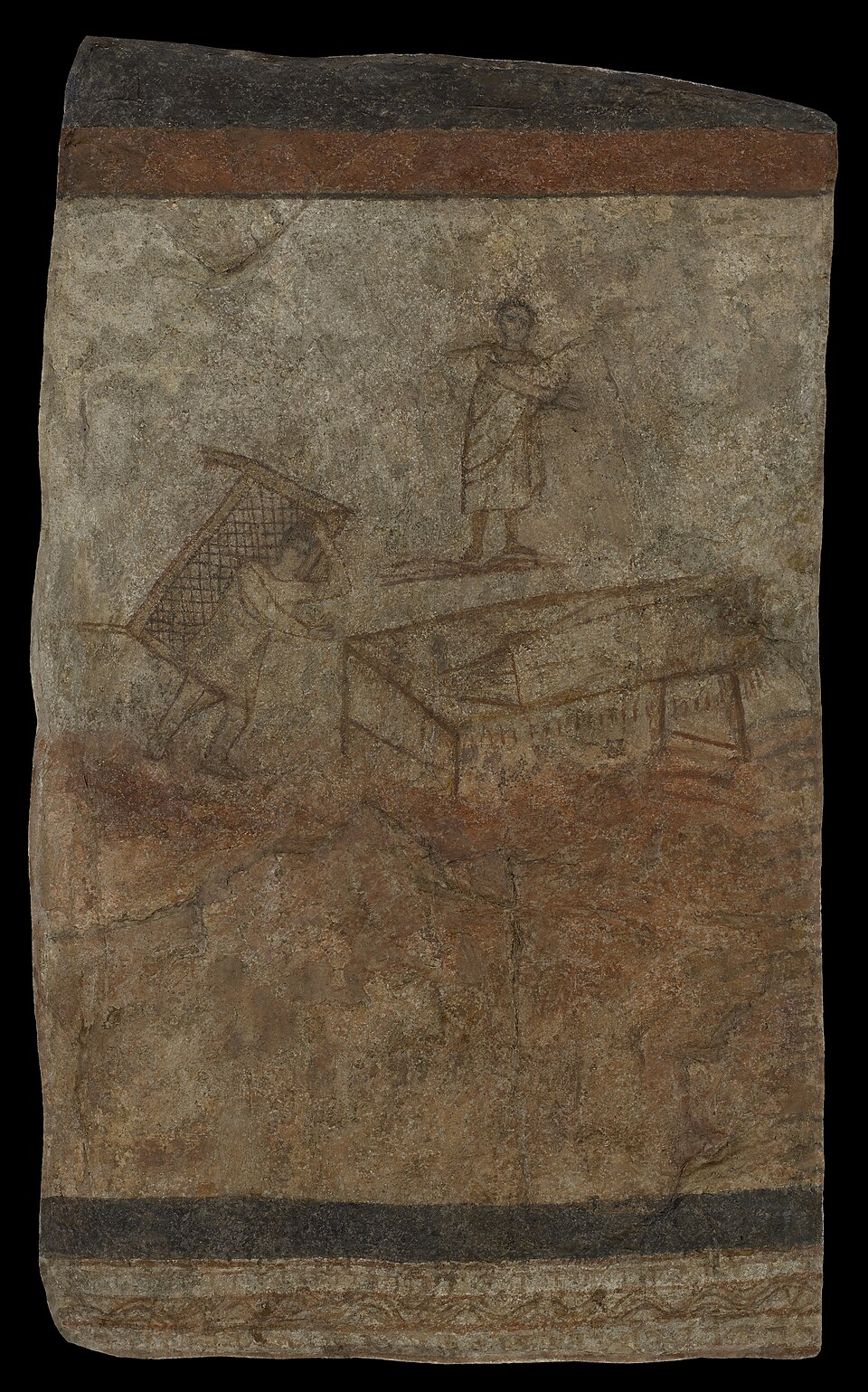
Pliny says Christians met on a fixed day before dawn, addressed a prayer to Christ as to a god and shared a harmless meal (Letters 10.96). In the first century believers met in private houses. At Dura-Europos in Roman Syria, excavators found a Christian building with a baptistery whose wall paintings the Yale University Art Gallery dates to about AD 232. Lactantius shows that by AD 303 at least one city, Nicomedia, had a church building prominent enough to be seen from the emperor’s palace (Lactantius 12).
Leaders and discipline
Ignatius pictures a bishop, elders and deacons together, with the Eucharist and baptism under the bishop’s authority (Smyrnaeans 8). By Cyprian’s time the question is what to do with those who gave way in persecution. He writes that some had defiled their conscience with “wicked certificates” and urges the martyrs and confessors in prison to keep to the discipline of the Gospel (Epistle 10). Cyprian’s treatise On the Lapsed ends with a warning against the Novatians, the followers of Novatus.
Glossary
| Term | Meaning on this page |
|---|---|
| Apology | A defense of Christianity addressed to outsiders, such as Justin’s to the emperor and Tertullian’s to the Roman authorities |
| Bishop | From the Greek episkopos, overseer. In this era, the head of a local church |
| Canon | The list of books accepted as Scripture. From a Greek word for a rule or measuring rod |
| Catholic | From the Greek for “universal”. See the debate above |
| Confessor | A Christian who openly declared the faith under threat and survived |
| Eucharist | From the Greek for “thanksgiving”. The shared bread and cup, also called the Lord’s Supper |
| Gnostic | A label scholars use for several teachers who claimed secret knowledge; whether it names a single movement is debated |
| Lapsed | Christians who gave way under persecution, for example by sacrificing to the gods |
| Martyr | From the Greek for “witness”. Someone killed for refusing to deny the faith |
| Montanism | The movement that followed Montanus, a prophet in Phrygia |
| Presbyter | An elder |
| Proconsul | The governor of a province run by the Senate, such as Asia |
| Prefect | A Roman official; the prefect of Rome kept order in the city |
| Rescript | An imperial reply or order |
| Sacrifice | In persecution, an act of offering to the gods or the emperor that Christians were asked to perform to prove they were not Christians |
Further reading
Modern scholarship is cited here, not copied. These books are a starting point, and they disagree with one another on purpose. Titles and years were checked against the Open Library catalogue in November 2026.
- Henry Chadwick, The Early Church (Pelican History of the Church; Penguin, 1993 printing of the revised edition). A single-volume survey that covers this whole era, including single bishops, Nag Hammadi and the persecutions.
- Harry Y. Gamble, The New Testament Canon: Its Making and Meaning (1985). How the list of books came together.
- Robert L. Wilken, The Christians as the Romans Saw Them (second edition, 2003). How outsiders such as Pliny and Celsus saw Christians.
- Candida Moss, The Myth of Persecution (2013). A challenging reading of the persecution stories; one view, not a settled one.
- Raymond E. Brown, An Introduction to the New Testament (1997). The usual dating of 2 Peter.
- Carl H. Kraeling, The Christian Building (The Excavations at Dura-Europos, Final Report VIII, Part II; 1967). The Dura-Europos building and its paintings.
- The Cambridge History of Christianity, Volume 1: Origins to Constantine, edited by Margaret M. Mitchell and Frances M. Young (Cambridge University Press). A broad survey of the period.
Ignatius's journey to Rome
One journey from this era that the sources let us follow, stop by stop. Dates are debated, so none are shown.
Ignatius on the road to Rome
Eusebius says Ignatius was sent from Syria to Rome under military guard, and that he wrote from Smyrna and from Troas. Polycarp's letter speaks of the patience the Philippians had seen in Ignatius, which suggests he passed through Philippi. The sources used here do not record the rest of the way, so the lines between these stops are straight and show only the order.
- 1Antioch, Ignatius is bishop here and is sent to Rome.
- 2Smyrna, He meets Polycarp and writes to Ephesus, Magnesia, Tralles and Rome.
- 3Troas, He writes to Philadelphia, Smyrna and Polycarp.
- 4Philippi, Polycarp speaks of the patience the Philippians saw in Ignatius, Zosimus and Rufus.
- 5Rome, He writes that he expects to face wild beasts here.
Key events
2 Peter is written
The letter claims to be by Simon Peter and speaks of Paul's letters and of the other scriptures. Raymond Brown reports that most scholars date it after Peter's death, to the early or middle second century, which would make it one of the last books of the New Testament. In the early fourth century Eusebius still lists it among the disputed writings.
Ignatius is taken to Rome, and writes seven letters
Ignatius, bishop of Antioch in Syria, was arrested and sent to Rome to face the wild beasts. On the way he wrote letters to Christian communities in Asia and to the church in Rome. He urges each church to keep together under its bishop, and in his letter to Smyrna he writes that wherever Jesus Christ is, there is the catholic church, which the editor of our translation calls the first use of the phrase in the writings of the church fathers. In the Greek it means the universal church, not a particular denomination. Eusebius places his death under Trajan, and his Chronicle gives AD 107; the translator of our edition reports that Lightfoot and Zahn keep the reign of Trajan but give up that year, and that Harnack moved it to the reign of Hadrian.
Pliny asks Trajan what to do with the Christians
Pliny, governor of Bithynia in northern Asia Minor, writes that he has never been present at the trial of Christians and does not know how far to punish them. He asks those accused whether they are Christians, asks a second and third time with a threat of punishment, and has those who persist punished; Roman citizens he sends to Rome. People who deny it and curse Christ he releases. He reports that Christians meet on a fixed day before dawn, address a prayer to Christ as to a god, and bind themselves by an oath not to steal, commit fraud or adultery, or break their word, and then share a meal. He calls it a contagious superstition. Trajan replies that Pliny has done right, that Christians are not to be hunted out, that anonymous accusations are not to be accepted, and that anyone who denies it and proves it by worshipping the gods is to be pardoned.
Polycarp writes to the church at Philippi
Polycarp, bishop of Smyrna, writes a short letter to the Philippians in which he says that the Philippians and Ignatius had asked him to forward their letters to Syria. He sends the letters of Ignatius that he has, and asks for news about Ignatius and those with him. The translator says the date cannot be settled and suggests about the middle of the second century, and notes that many have argued that chapter 13 was added later.
The Didache, Barnabas and the Shepherd of Hermas circulate
Three writings read by Christians of the time. The Didache is a short manual of Christian life and practice. The Muratorian fragment says the Shepherd was written in Rome in the time of Pius, and that it ought to be read but cannot be placed among the prophets or the apostles. Eusebius, in the early fourth century, counts the Shepherd, Barnabas and the Didache (the Teachings of the Apostles) among the books not accepted into the New Testament.
Marcion breaks with the church in Rome
Justin, writing in the middle of the century, says that Marcion of Pontus is even now teaching men to deny that God is the maker of heaven and earth, and that many have believed him. Irenaeus says Marcion cut the Gospel of Luke and Paul's letters to remove everything that called the Creator the Father of Jesus. The translator of our Eusebius says Marcion came to Rome about AD 135, tried to carry out his reforms there, and soon broke with the church. The Muratorian fragment rejects writings composed for him.
Justin describes baptism and Sunday worship
In his Apology, addressed to the emperor Antoninus Pius and written, he says, a hundred and fifty years after the birth of Christ, Justin tells the Romans how Christians worship. New believers are washed in water in the name of the Father, the Son and the Holy Spirit. On the day called Sunday everyone gathers in one place; the memoirs of the apostles or the writings of the prophets are read; the president speaks; they pray; bread and wine and water are brought and the people say Amen; and a portion is sent to those who are absent.
Polycarp is martyred at Smyrna
The letter from the church of Smyrna that records his death is, its editor says, the earliest of all the accounts of martyrs outside the New Testament. It says he was arrested, and that when the proconsul urged him to curse Christ he answered that he had served him eighty-six years. The letter names the proconsul as Statius Quadratus, and Eusebius places it under Verus. The year is debated: the translator of our Eusebius follows Waddington's case for about AD 155, under Antoninus Pius, while Eusebius's Chronicle points to AD 166 or 167. The editor also notes that many think parts of the account were added later.
Justin is tried and executed in Rome
According to the surviving account of his trial, Justin and six companions were condemned by Rusticus, the prefect of Rome, when they refused to sacrifice to the gods. Eusebius says Justin had been plotted against by the philosopher Crescens. The translator of the edition we use says the date is very hard to determine, and that the tradition placing it under Marcus Aurelius has the most in its favor, since Rusticus became prefect of Rome in AD 163.
Montanus and the new prophecy
A hostile writer quoted by Eusebius says that a recent convert named Montanus first appeared in a village in Mysia, on the border of Phrygia, when Gratus was proconsul of Asia. The writer says the church at Ancyra in Galatia was agitated by what the movement called prophecy and he called false prophecy, and that he had long hesitated to write against it for fear of seeming to add to the Gospel of the New Testament. The translator of our edition says the date cannot be fixed: Eusebius's Chronicle gives AD 172, and Epiphanius gives AD 156 or 157. We know the movement mostly from its opponents.
The persecution at Lyons and Vienne
The churches of Vienne and Lyons in Gaul wrote a letter to the churches of Asia and Phrygia about the sufferings of their members, and Eusebius quotes it at length. It tells of Pothinus, bishop of Lyons, who was more than ninety years old and died after he was dragged before the judge. Eusebius dates it to the seventeenth year of the emperor Antoninus Verus, which the translator gives as AD 177, though Eusebius's Chronicle puts it ten years earlier. The translator also argues that the letter does not justify describing the persecution as wholesale.
Celsus writes the True Discourse against Christianity
The Greek philosopher Celsus argued that Christians formed secret associations against the law and spread their teaching among the uneducated. His book is lost, and it survives only in the long reply that Origen wrote in the next century. Origen himself was unsure which Celsus it was; the editor of our translation reports the view that it was written under Marcus Aurelius (AD 161 to 180).
Irenaeus writes Against Heresies
Irenaeus, bishop of Lyons, answers Valentinus, Marcion and other teachers by appealing to the churches that the apostles founded and to the tradition handed down in them. He also argues that the Gospels cannot be more or fewer than four, because there are four zones of the world and four principal winds. He says Eleutherus is now bishop of Rome, which the translator of our Eusebius dates to about AD 175 to 189.
The Muratorian fragment lists books of the New Testament
A damaged Latin list, found in a manuscript in Milan and named after the man who published it in 1740, which names Luke as the third Gospel and John as the fourth, and lists Acts, thirteen letters of Paul, and the Apocalypse. It says Hermas wrote in Rome in the time of Pius and that the book ought to be read but not placed among the prophets or the apostles, and it rejects letters written in Paul's name against Marcion. The fragment says Hermas wrote very recently, in its own times, and the translator of the edition we use thinks the writer belongs to the latter half of the second century. Harry Gamble discusses the case some scholars make for the fourth century instead, so the date is debated.
Easter: Victor of Rome and the churches of Asia
The churches of Asia kept the Lord's passover on the fourteenth day of the Jewish month, on whatever day of the week it fell; the other churches kept it only on Sunday. Eusebius reports that Victor, bishop of Rome, tried to cut off all of Asia, and that other bishops, among them Irenaeus, rebuked him. Irenaeus recalls that Polycarp and Anicetus of Rome, who disagreed on this, still made peace with each other. Eusebius says Victor became bishop in the tenth year of Commodus, which the translator gives as AD 189; his successor followed about AD 200.
Tertullian defends Christians in his Apology
Tertullian, a Latin writer from Carthage, wrote an Apology addressed to Roman authorities in which he says the more Christians are mown down, the more they grow. The blood of Christians, he says, is seed. The editor of our translation notes great disagreement about its date, from AD 198 to 204.
Perpetua and Felicitas are martyred at Carthage
The Passion of Perpetua and Felicitas, which includes parts written by Perpetua herself and her companion Saturus, is a rare account written in part by a martyr herself. The translator's notes date it to the reign of Septimius Severus, about AD 202, and to Carthage, and say some think the narrator was a Montanist.
Decius's persecution: bishops arrested and many give way
Eusebius says that Decius, who hated his predecessor Philip, began a persecution of the churches in which Fabian was martyred at Rome and Alexander of Jerusalem and Babylas of Antioch died in prison after confessing. Cyprian's letters and his treatise On the Lapsed deal with what followed: many Christians had sacrificed to the gods, or had got false certificates, and the church had to decide how to take them back. Henry Chadwick describes it as the first persecution ordered for the whole empire; Eusebius does not describe it that way. The editor of Cyprian's works dates its outbreak to AD 250.
The lapsed, Novatus and the unity of the church
Cyprian, bishop of Carthage, wrote On the Unity of the Church to hold his church together, insisting that anyone cut off from the church is a stranger and an enemy and cannot have God as Father who does not have the church as mother. Eusebius records the dispute under the name of Novatus (Novatian). The rule for taking back those who had given way, and whether to rebaptize those baptized by heretics, divided church leaders; Eusebius says Cyprian and the bishops with him were the first to teach that it was necessary.
Paintings in a Christian building at Dura-Europos
At Dura-Europos, in Roman Syria, the Yale-French excavations of 1928 to 1937 uncovered a Christian building with a baptistery whose walls were painted with scenes such as Christ healing the paralytic. The Yale University Art Gallery, which now holds the paintings, dates them to about AD 232.
Valerian's order against bishops
Cyprian writes that Valerian had sent a rescript to the Senate: bishops, elders and deacons were to be punished at once; senators and knights were to lose their rank and property and, if they persisted, their heads; and women were to lose their property and be exiled. He reports that Xistus, the bishop of Rome, was killed in the cemetery with four deacons. The editor dates Cyprian's letters from exile to AD 257 and this one to AD 258, shortly before Cyprian's own death.
The Great Persecution begins at Nicomedia
Lactantius says that on the festival of Terminus, 23 February, in the eighth consulship of Diocletian and the seventh of Maximian, the prefect and officers broke into the church in Nicomedia, burned the books of Scripture and looted its furnishings, and soldiers then razed the building within a few hours while Diocletian and Galerius watched from the palace. The translator of our Eusebius dates the start of the persecution to AD 303.
Galerius gives Christians leave to exist again
In an edict preserved by Lactantius, Galerius says the emperors had tried to bring Christians back to the ancient institutions, that many had given way, but that many still refused both to worship the gods and to worship their own God, and that he therefore permits them to be Christians again and to hold their meetings, provided that they do not break the peace. They are to pray to their God for the emperor and for the state. Lactantius says it was published at Nicomedia on 30 April, and Galerius died a few days later; the translator of our Eusebius gives the year of his death as AD 311.
Constantine and the Milvian bridge
Lactantius says that when Constantine camped by the Milvian bridge before the battle with Maxentius, he was told in a dream to mark the heavenly sign on his soldiers' shields. Eusebius gives a different account, in which the emperor told him long afterwards that he had seen a cross of light in the sky at midday with the words Conquer by this. Maxentius died at the bridge in AD 312, according to the translator of our Eusebius.
The Milan agreement of Constantine and Licinius
Lactantius preserves the text of a document issued at Nicomedia on the ides of June, which says Constantine and Licinius had met at Milan and agreed that Christians and everyone else should be free to follow the religion each chose. It orders places of worship and church property to be returned to the Christians. It is often called the Edict of Milan, but Lactantius's text was issued at Nicomedia, is addressed to a provincial governor, and protects all religions. Lactantius dates it to the year when Licinius and Constantine were consuls for the third time, AD 313.
Key people
Ignatius of Antioch
Eusebius says he was taken from Syria to Rome as a prisoner and, on the way through Asia, wrote letters to the churches of Ephesus, Magnesia, Tralles and Rome from Smyrna, and from Troas to the churches of Philadelphia and Smyrna and to Polycarp. In the letter to Rome he writes that from Syria to Rome he fights with wild beasts, bound to ten leopards, which he explains as a band of soldiers. His letters press hard for one bishop in each church, with elders and deacons under him.
Polycarp
Irenaeus, who says he saw Polycarp in his youth, writes that Polycarp was taught by apostles, was appointed bishop of Smyrna by apostles in Asia, and visited Rome in the time of Anicetus. Polycarp's own short letter to the Philippians mentions Ignatius and says he is sending on the letters of Ignatius that he had. The account of his death says that when the Roman governor urged him to curse Christ, he answered that he had served him for eighty-six years.
Pliny the Younger
A Roman senator, consul in AD 100, who as governor of Bithynia in northern Asia Minor wrote to the emperor Trajan to ask how to treat Christians brought before him. Pliny was not a Christian, which is why his letter and Trajan's reply are so valuable. Robert Wilken treats the pair as the earliest surviving official Roman view of Christians; see Further reading.
Justin Martyr
Writes an Apology addressed to the emperor Antoninus Pius in which he describes how Christians baptize and meet on Sundays, and he says Marcion is teaching in his own day. Eusebius says he was a philosopher who preached the word in Rome and that a rival, the Cynic Crescens, plotted against him. The surviving record of his trial says he was condemned by Rusticus, the prefect of Rome, for refusing to sacrifice.
Marcion
Justin says Marcion taught that the creator was not the father of Christ and preached another god. Irenaeus adds that Marcion cut down the Gospel of Luke, removed what it said about the birth of Jesus, and also dismembered the letters of Paul. Irenaeus says he set aside the prophets and the law. Harry Gamble discusses how far Marcion's own short list of Christian writings pushed other Christians to say what theirs was; see Further reading.
Irenaeus
He writes that as a boy he saw Polycarp in lower Asia, and he was later bishop of Lyons in Gaul. In Against Heresies he argues from the churches founded by the apostles against Marcion, Valentinus and others, and he argues that there must be four Gospels, no more and no fewer. He also wrote to Victor, bishop of Rome, to urge peace in the dispute about Easter.
Celsus
Known only from the long reply by Origen, who quotes his work, the True Discourse. Celsus charged that Christians formed secret associations against the law, and he sneered that they spread their message through wool-workers, cobblers and fullers who spoke to children and ignorant women in private houses. Origen answers him point by point.
Victor of Rome
Eusebius says that Victor tried to cut off all the churches of Asia, who kept Easter on the fourteenth day of the Jewish month, as heterodox, and declared them excommunicate. Other bishops, including Irenaeus, rebuked him.
Tertullian
Jerome says he came from Carthage in the province of Africa and flourished under the emperors Severus and Caracalla. His Apology defends Christians to the Roman authorities. In it he tells them that the more they mow Christians down the more Christians grow, for the blood of Christians is seed. He also wrote a long work against Marcion, and Jerome says he later went over to the teaching of Montanus.
Origen
Eusebius gives him much of book 6 of his Church History. He says Origen moved from Alexandria to Caesarea, wrote his eight books against Celsus when he was over sixty, and suffered in the persecution under Decius.
Cyprian
Bishop during the Decian persecution and after it. In On the Unity of the Church he writes that a person cannot have God as Father who does not have the church as mother. Cyprian's own letters show him writing to confessors in prison during the Decian persecution, and later urging his colleagues to prepare their churches for martyrdom when Valerian's order arrived.
Diocletian
Lactantius says the emperor and his colleague Galerius watched from the palace at Nicomedia while soldiers destroyed the Christian church there, and that the day chosen was the festival of Terminus. This began the persecution that the translator of our Eusebius calls the great persecution.
Constantine
Lactantius says he was told in a dream to put the heavenly sign on his soldiers' shields before the battle at the Milvian bridge. Eusebius, writing his Life of Constantine, says the emperor himself told him, and swore, that he saw a cross of light in the sky above the sun with the words Conquer by this.
Sources for this era
- Ignatius, Polycarp, Martyrdom of Polycarp, Barnabas, Justin Martyr, Irenaeus, Ante-Nicene Fathers, volume 1 (CCEL)
- The Shepherd of Hermas, Ante-Nicene Fathers, volume 2 (CCEL)
- Apology; Against Marcion; Passion of Perpetua and Felicitas, Tertullian and others, Ante-Nicene Fathers, volume 3 (CCEL)
- Against Celsus, Origen, Ante-Nicene Fathers, volume 4 (CCEL)
- Letters of Cyprian; the Muratorian fragment, Ante-Nicene Fathers, volume 5 (CCEL)
- Of the Manner in Which the Persecutors Died, Lactantius, Ante-Nicene Fathers, volume 7 (CCEL)
- Church History and Life of Constantine, Eusebius of Caesarea, Nicene and Post-Nicene Fathers, second series, volume 1 (CCEL)
- City of God, Augustine, Nicene and Post-Nicene Fathers, first series, volume 2 (CCEL)
- Letters of Pliny, Pliny the Younger, translated by William Melmoth, edited by F. C. T. Bosanquet (Project Gutenberg 2811)
- 2 Peter, New Testament, World English Bible (eBible.org)
- An Introduction to the New Testament, Raymond E. Brown (1997)
- Modern studies of the early church, Henry Chadwick; Harry Y. Gamble; Robert L. Wilken; Candida Moss
- Lives of Illustrious Men, Jerome, Nicene and Post-Nicene Fathers, second series, volume 3 (CCEL)
- Baptistery wall painting: Christ Healing the Paralytic, Yale University Art Gallery, object 1932.1202