
After Chalcedon
From the council of Chalcedon to Gregory the Great: the western empire falls, Latin and Greek Christianity drift apart, monks and popes take on new roles, and Christianity spreads to the English.
Churches and cities about 600
Churches and cities of the era of Justinian and Gregory the Great, from Canterbury to Jerusalem. No borders are drawn.
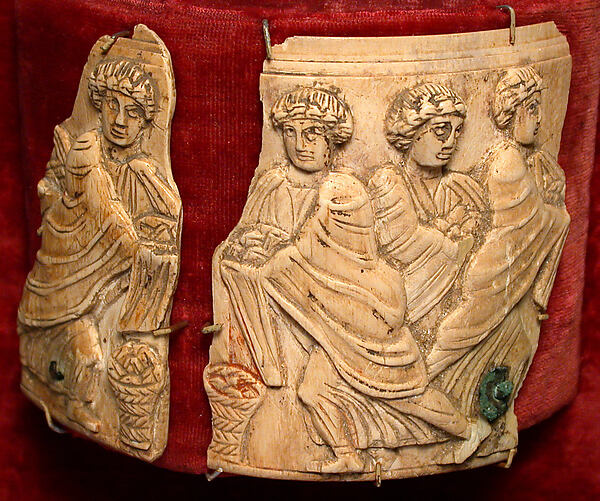
Images from the period
Overview
The third era ended with the council at Chalcedon, which left the church divided in the East over the person of Christ. This era starts there. Over the next century and a half the West lost its emperors: Procopius tells how the young emperor Augustulus was set aside in Italy. The eastern empire, with its capital at Constantinople, held together, and Justinian says his armies brought Africa and other provinces back under Rome. In the West, bishops, monks and kings took up the work of government and learning, and the letters of Gregory the Great show a bishop of Rome managing estates and negotiating with a king.
The page is arranged by East and West, as before. Each event says which region it belongs to. Where a story belongs to both, it is marked “East and West”.
The later split between the Roman Catholic and Orthodox churches had not happened. The splits on this page are older ones: the Church of the East, after the council at Ephesus (AD 431), and the churches now called Oriental Orthodox, after Chalcedon (AD 451), as Henry Chadwick describes. Those separate churches are not a mistake to correct later; they are part of the story.
When were the sources written?
| Writing | Usual date | Notes |
|---|---|---|
| Leo, Letter 28 (the Tome) | AD 449 | Read in the third era |
| Patrick, Confession | Fifth century | The editor gives AD 455; other chronologies are later |
| Boethius, Consolation of Philosophy | c. AD 523 | Written in prison, within a year of 522 |
| Justinian, Institutes | 21 November, in his third consulship | The date at the end of the preface |
| Gregory the Great, Pastoral Rule | c. AD 590 | Written at the start of his time as bishop (preface) |
| Gregory the Great, Letters | AD 590 to 604 | His time as bishop, in the editor’s dates |
| Gregory of Tours, History of the Franks | Finished AD 594 | Its epilogue, the year of his death, the translator says |
| Isidore, Etymologies | Before AD 636 | His last years; left unfinished |
| Bede, Ecclesiastical History | Finished AD 731 | The translator’s introduction |
Key beliefs and debates
Did Chalcedon heal the church?
No. The council at Chalcedon, in AD 451, defined the two natures of Christ. Churches in Egypt and Syria refused the definition and kept their own bishops. Henry Chadwick describes Justinian’s attempts to bring them back. The council he called in 553 condemned three earlier writings. Its record shows the argument turning on whether the letter of Ibas had been approved at Chalcedon, and Pope Vigilius first resisted and then gave way.
Was the western empire’s end sudden?
The year usually given is AD 476, when, Procopius says, Odoacer set the young emperor aside and let him live as a private citizen. Procopius tells it as a change of ruler, not the end of a world: Odoacer gave a third of Italy to the barbarian allies and ruled for ten years. Henry Chadwick describes the end of the western empire as a gradual change rather than a sudden fall.
What did the Pastoral Rule ask of a bishop?
Gregory’s Pastoral Rule sets out the qualities a bishop needs, and it gives advice for leading people of different kinds. It says the ruler of souls must distinguish virtues from vices with careful attention, so that he is not misled by meanness that looks like thrift, or by an appearance of generosity. It was copied and read for centuries.
Did the English become Christian through Gregory?
Gregory’s letters show him sending Augustine of Canterbury and others to the English, and rejoicing in the conversion of the Angli. Bede, who finished his history in 731, tells the story in detail, more than a century later. Henry Chadwick discusses how much the Christians already in Britain and the Irish mission also contributed, and the page does not decide the question.
Worship and community life
Monks and the Rule
Benedict’s Rule for monks sets prayer seven times in the day, as the Prophet says (Rule 16). It says idleness is the enemy of the soul, so the brethren should be occupied at certain times in manual labor and at fixed hours in sacred reading (Rule 48), and it calls obedience without delay the first degree of humility (Rule 5). Henry Chadwick describes how its influence grew slowly in the West.
Bishops and the state
In the West, Gregory’s editor describes him managing St. Peter’s patrimony through agents and negotiating with the Lombard king. In the East, Justinian himself condemned the Three Chapters and called the council of 553 that condemned them.
Glossary
| Term | Meaning on this page |
|---|---|
| Abbot | The head of a monastery |
| Doctor of the Church | A title given to certain Christian teachers; Gregory’s editor calls him one of the great Doctors of the Church |
| Monophysite | A name used by opponents for churches that rejected the Chalcedon definition. These churches are now usually called Oriental Orthodox |
| Pastoral | Concerned with the care of people, as a bishop cares for his flock |
| Provost | An official in charge of a community, such as a monastery |
| Pyx | A small box, here one carved in ivory |
| Three Chapters | Three writings condemned by Justinian and the council of 553 |
Further reading
Modern scholarship is cited here, not copied. Titles and years were checked against the Open Library catalogue in November 2026.
- Henry Chadwick, The Early Church (Pelican History of the Church; Penguin, 1993 printing of the revised edition). Its last chapters cover this era.
- Peter Brown, The World of Late Antiquity (1971). The framework for the period.
- Averil Cameron, The Mediterranean World in Late Antiquity (1993). The East and the West together.
- Richard Fletcher, The Conversion of Europe (1997). Clovis, Augustine of Canterbury and the spread of the faith.
- Ian Wood, The Merovingian Kingdoms (1994). Gaul after the empire, with Gregory of Tours.
Key events
West: Leo meets Attila
The editor of Leo's works, following Prosper and others, says that when Attila's Huns invaded Italy, Rome sent Leo with two officials to meet him, that the meeting took place on Lake Benacus, and that Attila withdrew beyond the Danube. Leo himself makes only the slightest allusion to it. The editor sees no reason to doubt the account.
West: Vandals sack Rome
The Vandals under Genseric, who had taken North Africa, came to Rome. The editor of Leo's works says Leo went out at the head of the clergy to meet them, and that his pleas had some effect, but not enough to stop fourteen days of pillage.
West: The last western emperor is deposed
Procopius says the young emperor Augustus, called Augustulus, ruled the West with his father Orestes as regent. When Orestes refused the barbarian allies a third of Italy they killed him, and Odoacer, one of the emperor's bodyguards, took power, let the emperor live as a private citizen, and ruled for ten years. The translator dates this to AD 476. Henry Chadwick describes the change as gradual rather than sudden.
West: Clovis is baptized
Gregory of Tours says that Clovis, king of the Franks, vowed in a battle against the Alamanni to be baptized if Christ gave him victory, and that this happened in the fifteenth year of his reign. Remi, bishop of Rheims, baptized him, and more than three thousand of his army were baptized with him. The translator thinks the number may be exaggerated. The translator's table has Clovis's father dying in 481, which puts the fifteenth year near 496.
West: Patrick's mission to Ireland and his Confession
Patrick writes of his capture as a boy, his escape, his return to Ireland as a bishop, and his work among the Irish. The chronology in the edition used here puts the Confession in AD 455 and his death in 458, and notes that some chronologies put his life forty or forty-five years later.
West: Boethius writes The Consolation of Philosophy
Within a year of AD 522, the translator says, Boethius was a prisoner at Pavia, and he wrote his book there. It takes the form of a dialogue between himself and Philosophy, who appears to him in his prison.
West: Benedict writes his Rule
Benedict of Nursia's Rule sets prayer seven times in the day, says idleness is the enemy of the soul and fixes hours for manual labor and for reading, and calls obedience without delay the first degree of humility. The editor of Gregory the Great says Benedict founded his order about AD 530. Henry Chadwick describes Benedict at Monte Cassino and the Rule's later spread.
East: Justinian reigns and collects Roman law
Justinian reigned from 527 until his death in 565, the translator of Procopius says. His Institutes say the fifty books of the Digest had collected the older law, and that the Institutes, in four books, set out the first elements of law for students. They were given at Constantinople on 21 November, in Justinian's third consulship.
East: Hagia Sophia is rebuilt in Constantinople
Procopius says the rioters of the Nika revolt burned the church called Sophia, and that Justinian, sparing no expense, had it rebuilt by the architects Anthemius of Tralles and Isidore of Miletus. The translator of his Wars dates the revolt to January 532.
East: The Three Chapters and the Second Council of Constantinople
Justinian condemned three writings, the Three Chapters: the writings of Theodore of Mopsuestia, Theodoret's writings against Cyril, and a letter of Ibas of Edessa. The council he called in 553 condemned them. Pope Vigilius first resisted, then gave way. The council's record shows that the question was whether the letter of Ibas had been approved at Chalcedon, and some at the council argued that only Ibas's person was spared, not his letter.
East: Non-Chalcedonian churches organize separately
Henry Chadwick describes how, in Syria and Egypt, churches that rejected the Chalcedon definition organized their own bishops and clergy, how Justinian's policy towards them varied, and how these became the separate churches later known as Oriental Orthodox.
West: Gregory the Great is pope
Gregory wrote the Book of Pastoral Rule when he first became bishop, and sent it to Leander of Seville. His editor describes the church's lands in Sicily and elsewhere, St. Peter's patrimony, managed by agents under him, and says it was Gregory who arranged terms with the Lombard king Agilulf; letters of thanks for a settled peace date from 598 to 599. The editor calls him one of the great Doctors of the Church.
West: Augustine is sent to the English
Gregory sent Augustine, his former provost, with others to the English. The editor says they left Rome probably in the spring of 596, that Augustine turned back from Gaul to ask leave to give up, and that Gregory sent him on with a letter dated 23 July 596. Bede says they reached Kent in 597. In a later letter Gregory writes of joy that the nation of the Angli has put away the darkness of error and taken up the holy faith.
West: Isidore of Seville, bishop and encyclopedist
Isidore became bishop of Seville probably in 600 and died in 636. His Etymologies, which gathered extracts from earlier writers, was written at the request of Braulio of Saragossa in his last years and left unfinished, according to Ernest Brehaut's study.
Key people
Leo the Great
Known from the third era for his Tome. The editor of his works, following Prosper and other writers, says he met Attila the Hun in AD 452 and persuaded him to leave Italy, and that in 455 he went out to meet the Vandals. Leo himself barely alludes to either event.
Patrick
In his Confession he writes that he was taken captive to Ireland when he was nearly sixteen, served a master there for six years, fled to a ship, and later came back to the Irish people to preach the Gospel. He speaks of being given the rank of bishop.
Justinian
In the preface to his Institutes he says Africa and other provinces had been brought back under Rome, that he had cleared the inconsistencies from the imperial laws, and that the fifty books of the Digest had collected the older law. He also sought agreement among the churches, and the council of 553 that he called condemned writings of three earlier theologians, the Three Chapters.
Benedict of Nursia
Wrote a Rule for monks. The editor of Gregory the Great's works says he founded his order about ten years before Gregory was born, around AD 530, and that Gregory admired him and recorded his life in the Dialogues. Henry Chadwick describes how the Rule later became the common pattern for western monasteries.
Boethius
Consul in AD 510 and later head of the civil administration under Theodoric the Ostrogoth, according to the translator. Within a year of his sons' consulship in 522 he was a prisoner at Pavia, and there he wrote The Consolation of Philosophy, in which he says he had been condemned to death unheard.
Gregory the Great
Ordained bishop of Rome on 3 September 590; he died on 12 March 604, the editor of his works says. He wrote the Book of Pastoral Rule, a manual for bishops, at the start of his time as bishop. A passage says the ruler of souls must distinguish virtues from vices with vigilant care, lest he be ruled by meanness, or by pride in appearing generous. He sent Augustine to the English. His letters show him managing the church's property and its clergy from Rome.
Augustine of Canterbury
Gregory calls him the former provost of his monastery in Rome. Gregory sent him with others to the English in AD 596, and in a letter gives thanks for the nation of the Angli turning from idols to the faith. Bede says he reached Kent in 597.
Gregory of Tours
Wrote a history of the Franks that tells the story of Clovis's conversion and baptism. His translator dates his life from 538 to 594, the year he finished the History.
Isidore of Seville
Succeeded his brother Leander as bishop of Seville, probably in AD 600, and died in April 636. He wrote the Etymologies, an encyclopedia of learning, in his last years; it was left unfinished, and his friend Braulio divided it into twenty books.
Sources for this era
- Letter 28 (the Tome); the volume of Leo and Gregory, Leo the Great and Gregory the Great, Nicene and Post-Nicene Fathers, second series, volume 12 (CCEL)
- Gregory's letters, including those to and about Augustine of Canterbury, Gregory the Great (II), Ephraim Syrus, Aphrahat, Nicene and Post-Nicene Fathers, second series, volume 13 (CCEL)
- The Second Council of Constantinople (the Fifth Ecumenical Council) and the Three Chapters, The Seven Ecumenical Councils, Nicene and Post-Nicene Fathers, second series, volume 14 (CCEL)
- History of the Wars (Persian War; Gothic War) and Of the Buildings of Justinian, Procopius, translated by H. B. Dewing (Project Gutenberg 16764, 20298) and Aubrey Stewart (Project Gutenberg 65404)
- The Institutes of Justinian, Translated by J. B. Moyle (Project Gutenberg 5983)
- History of the Franks, Gregory of Tours, selections translated by Ernest Brehaut, 1916 (Project Gutenberg 74955)
- The Confession of St. Patrick, In The Most Ancient Lives of Saint Patrick, edited by James O'Leary (Project Gutenberg 18482)
- The Consolation of Philosophy, Boethius, translated by H. R. James (Project Gutenberg 14328)
- St. Benedict's Rule for Monasteries, Translated by Leonard J. Doyle (Project Gutenberg 50040)
- Ecclesiastical History of England, Bede, translated by A. M. Sellar (Project Gutenberg 38326)
- An Encyclopedist of the Dark Ages: Isidore of Seville, Ernest Brehaut (1912; Project Gutenberg 51511)
- Pyx Fragments with the Multiplication of the Loaves and Fishes, Metropolitan Museum of Art, 2021.37.24a, b (object 330095)
- Modern studies of the period, Henry Chadwick; Peter Brown; Averil Cameron; Richard Fletcher; Ian Wood